
Streamflow forecasting under non-homogeneous and discontinuous data conditions using LSTM: Application to Nam Pan basin
Keywords
LSTM, Nam Pan river basin, flow forecasting, small mountainous catchment
Abstract
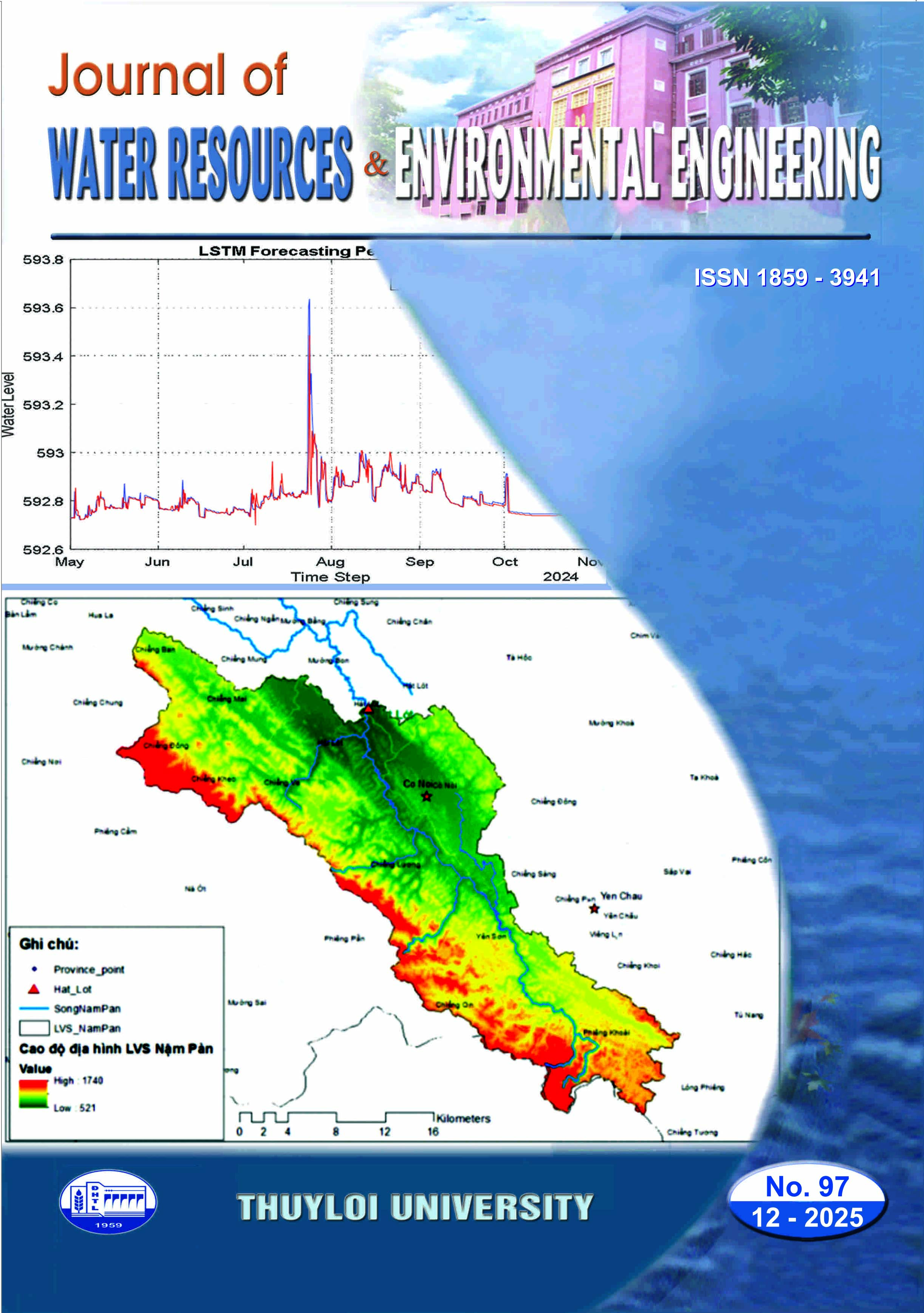
Streamflow forecasting in small mountainous basins faces significant challenges due to non-homogeneous and discontinuous observational data caused by sensor failures, irregular sampling, and missing records. This study presents a Long Short-Term Memory (LSTM) deep learning approach to handle discontinuous time series for water level forecasting in the Nam Pan River basin, northern Vietnam. The methodology integrates multiple data preprocessing techniques including linear and PCHIP interpolation, outlier removal, and Z-score normalization to address data irregularities. Input features comprise rainfall observations from multiple stations, lagged water levels (6–24 hours), and cyclical time encoding. The LSTM model achieves Nash–Sutcliffe Efficiency of 0.86–0.91 for 6-hour forecasts and 0.70–0.78 for 24-hour forecasts, with R² values of 0.88–0.94 and forecast assurance of 82–90%. Results demonstrate the model's robustness in handling imperfect data, confirming its applicability for operational flash flood early warning systems in data-limited mountainous catchments. Keywords: LSTM, Nam Pan river basin, flow forecasting, small mountainous catchmentDownloads
Download data is not yet available.
Downloads
Published
2026-01-23
Issue
Section
SCIENTIFIC ARTICLE


