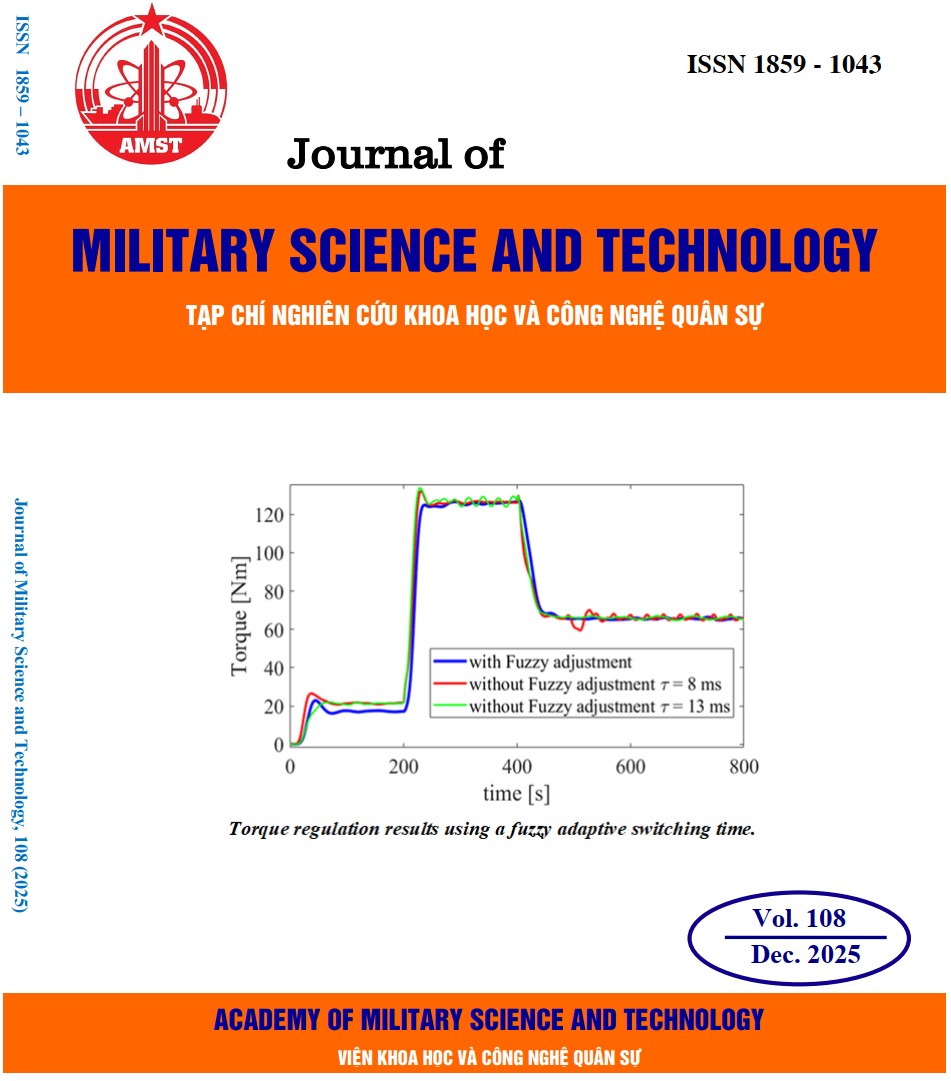
Reducing the output torque ripple of switching reluctance motors using a fuzzy logic system
Abstract
Torque control for the Switched Reluctance Motor (SRM) is always a complex problem because continuous switching between phases is required during operation. This inherent characteristic often causes the SRM's torque profile to fluctuate significantly [1]. In recent years, researchers have endeavored to investigate control methods aimed at improving the torque characteristics of the SRM. These methods have relied on experimental approaches to select appropriate switching times (or switching angles) [2-4]. In a previous paper, we proposed a data table for selecting the switching time based on the reference speed [14]. To enhance the effectiveness of the proposed solution, in this paper, a Fuzzy Logic System (FLS) is constructed to automate the process of selecting the switching time for the SRM. The FLS is built upon the Takagi-Sugeno (TS) fuzzy model. The fuzzy inference system is implemented using the SUMPROD principle, and defuzzification is performed using the Center of Gravity (CoG) method. The TS fuzzy system is trained using the Steepest Gradient method. The research results will be analyzed through digital simulation.