Research on the influence of cutting parameters and optimization of spherical surface form error in ultra-precision turning using Box-Behnken and Genetic Algorithm
Abstract
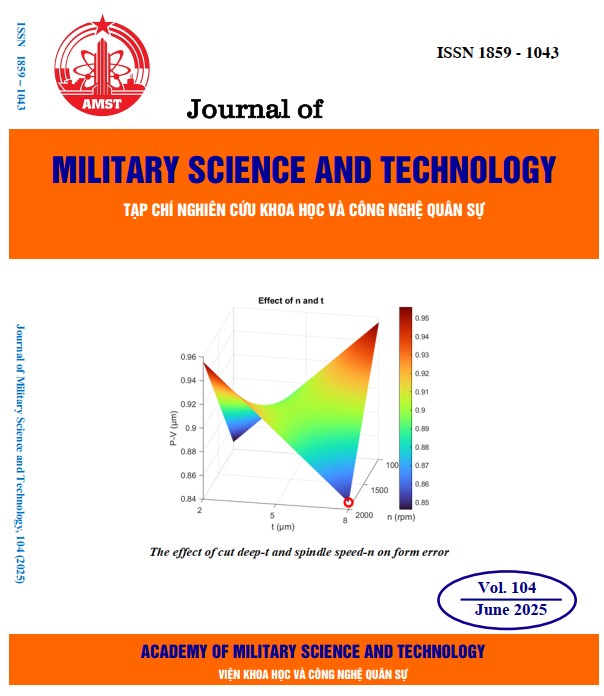
Ultra-precision diamond turning is a crucial method in manufacturing optical components and precision mechanical parts, especially for machining spherical surfaces. However, the form error of the machined surface is influenced by various factors such as spindle speed, depth of cut and feed rate. This study analyzes the effects of cutting parameters on form error when machining spherical surfaces on an ultra-precision lathe. Fifteen experiments were conducted with machining parameters, including spindle speed, feed rate, and depth of cut, within the recommended range of the lathe. A form error model was developed based on the Box-Behnken model to simulate and evaluate the accuracy of the machined surface. Experimental analysis shows that all machining parameters significantly affect form error. Increasing or decreasing both spindle speed and depth of cut reduces form error, while increasing feed rate generally leads to higher form error. The Genetic Algorithm (GA) was applied to optimize cutting parameters, achieving a minimum form error of 0.846 µm with an optimal spindle speed of 2000 rpm, feed rate of 5 µm/min, and depth of cut of 8 µm. This study develops a predictive model for form error in diamond turning of spherical surfaces and optimizes cutting parameters. It also improves understanding of how machining parameters affect form error, aiding process prediction and optimization for better machining quality in single-point diamond turning (SPDT).