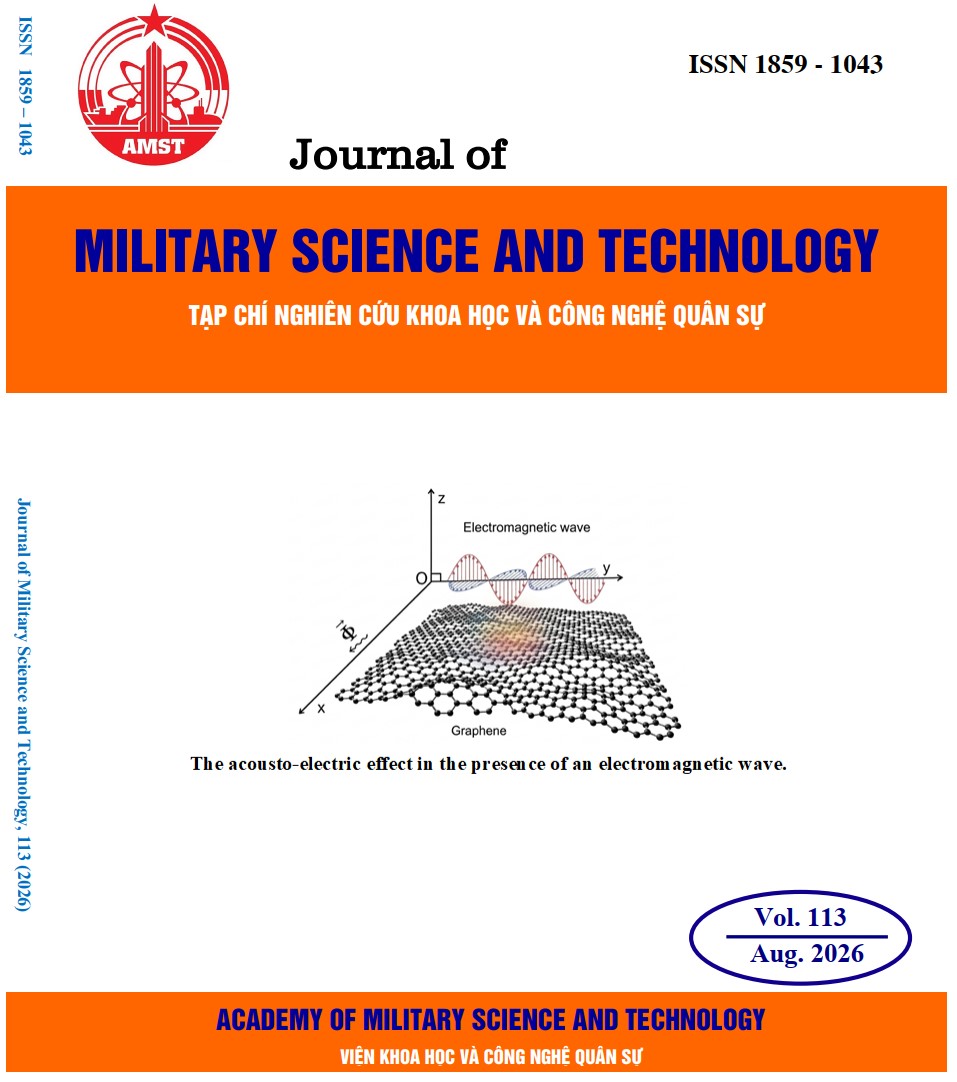
Acousto-electric current in graphene under the influence of electromagnetic waves
Keywords
DOI:
https://doi.org/10.54939/1859-1043.j.mst.113.2026.135-141Abstract
Two-dimensional graphene has garnered significant interest owing to its unique quantum behaviors stemming from a linear energy dispersion relation, with the acoustic-electric (AE) effect emerging as a key phenomenon driven by charge carrier dynamics under surface acoustic waves (SAW). Classical models based on the Boltzmann kinetic equation, effective at elevated temperatures, fall short in accounting for low-temperature experimental data. This work adopts the quantum kinetic equation approach to analyze the AE current in monolayer graphene subjected to combined SAW and electromagnetic waves (EMW). We derive an analytical formula for the AE current that fully captures the electron-acoustic phonon scattering via the deformation potential mechanism and elucidates SAW's role. Numerical simulations reveal the AE current's nonlinear rise with temperature, alongside sharp declines with increasing material sound velocity and EMW parameters. These trends highlight the potential for precise control of AE current via external stimuli. By advancing from classical to quantum frameworks, this study offers deeper insights into the AE effect's fundamentals in two-dimensional graphene.