
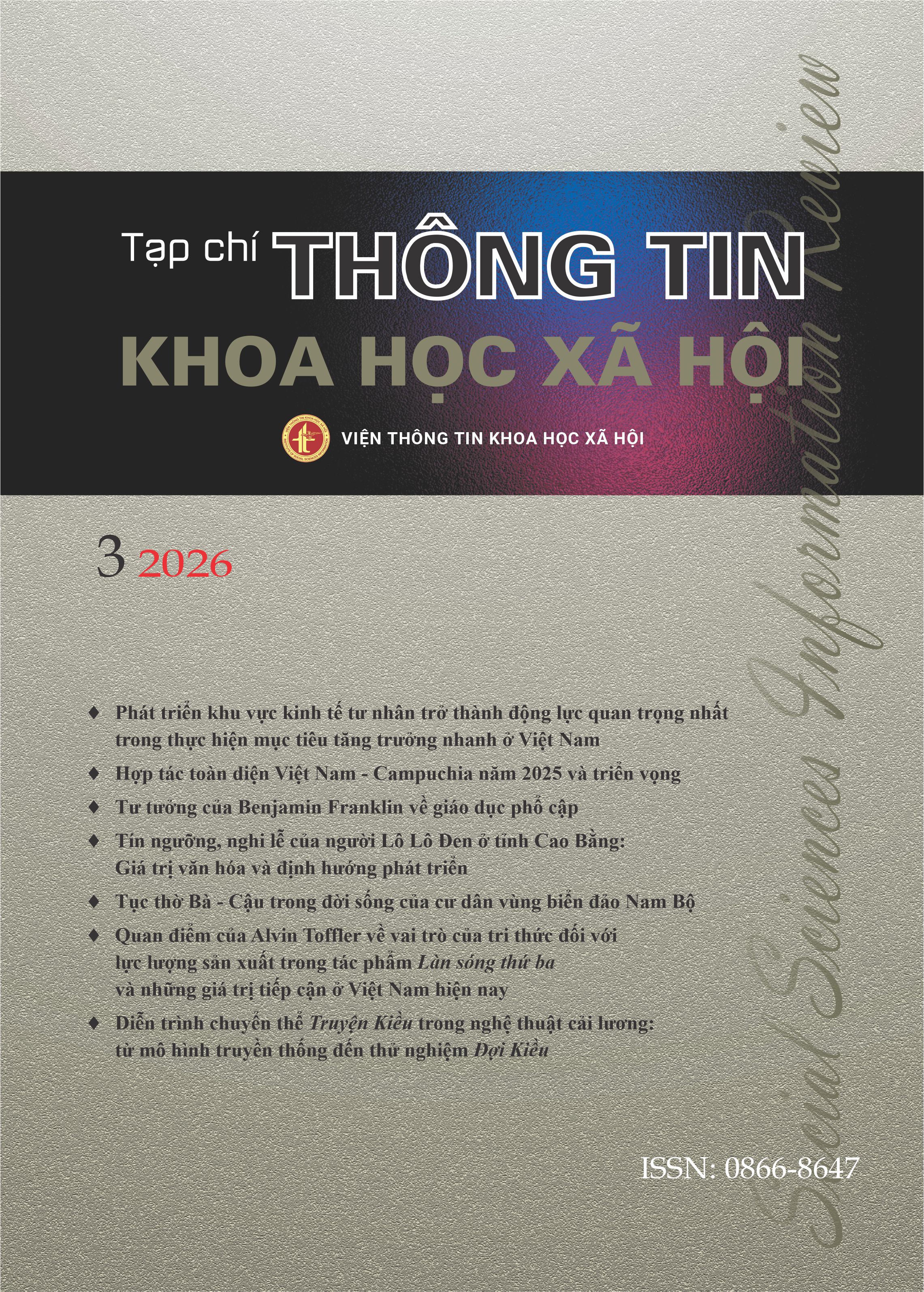
Benjamin Franklin’s Thought on Universal Education
Keywords
Abstract
Benjamin Franklin (1706-1790), among the Founding Fathers of the United
States, stands as a leading intellectual figure of the American Enlightenment whose contributions extended significantly to the educational philosophy. For Franklin, education was not a privilege reserved for the elite, but a universal process intended to
make knowledge the common property of society. This article analyzes Franklin’s thought on universal education, thereby clarifying the enduring educational significance of his thought and contributing to the study of the world philosophy of education in Vietnam. The study is grounded in the methodological framework of dialectical materialism and adopts a combination of complementary research methods, including deduction and induction, analysis and synthesis, classification and systematization, comparative analysis, as well as historical-logical and system-structural approach.
Downloads
Downloads
Published
Issue
Section
License
Tác giả xuất bản bài viết của mình trên tạp chí này đồng ý với những điều khoản sau:- Tác giả vẫn giữ bản quyền và trao cho tạp chí quyền xuất bản lần đầu tiên và sau [số tháng] phát hành tác phẩm theo giấy phép Creative Commons Attribution Licensecho phép những người khác chia sẻ tác phẩm đó với điều kiện nêu rõ tác giả và nơi xuất bản đầu tiên.
- Tác giả có thể ký kết những thỏa thuận riêng rẻ khác mang tính hợp đồng đối với việc phát hành không độc quyền phiên bản của tác phẩm in trên tạp chí này (v.d., đưa vào một kho dữ liệu của một cơ quan hoặc đưa vào một cuốn sách), với điều kiện nêu rõ nơi xuất bản đầu tiên.
- Tác giả được phép và được khuyến khích đưa bài viết của mình lên mạng (v.d., trong các kho dữ liệu cơ quan hoặc website của tác giả) trước và trong quá trình nộp bài viết vì nó có thể đưa lại những trao đổi hiệu quả cũng như giúp tác phẩm có nhiều địa chỉ trích dẫn hơn (Xem Hiệu lực của Truy cập Tự do).
